
Hydrogen Sulfide
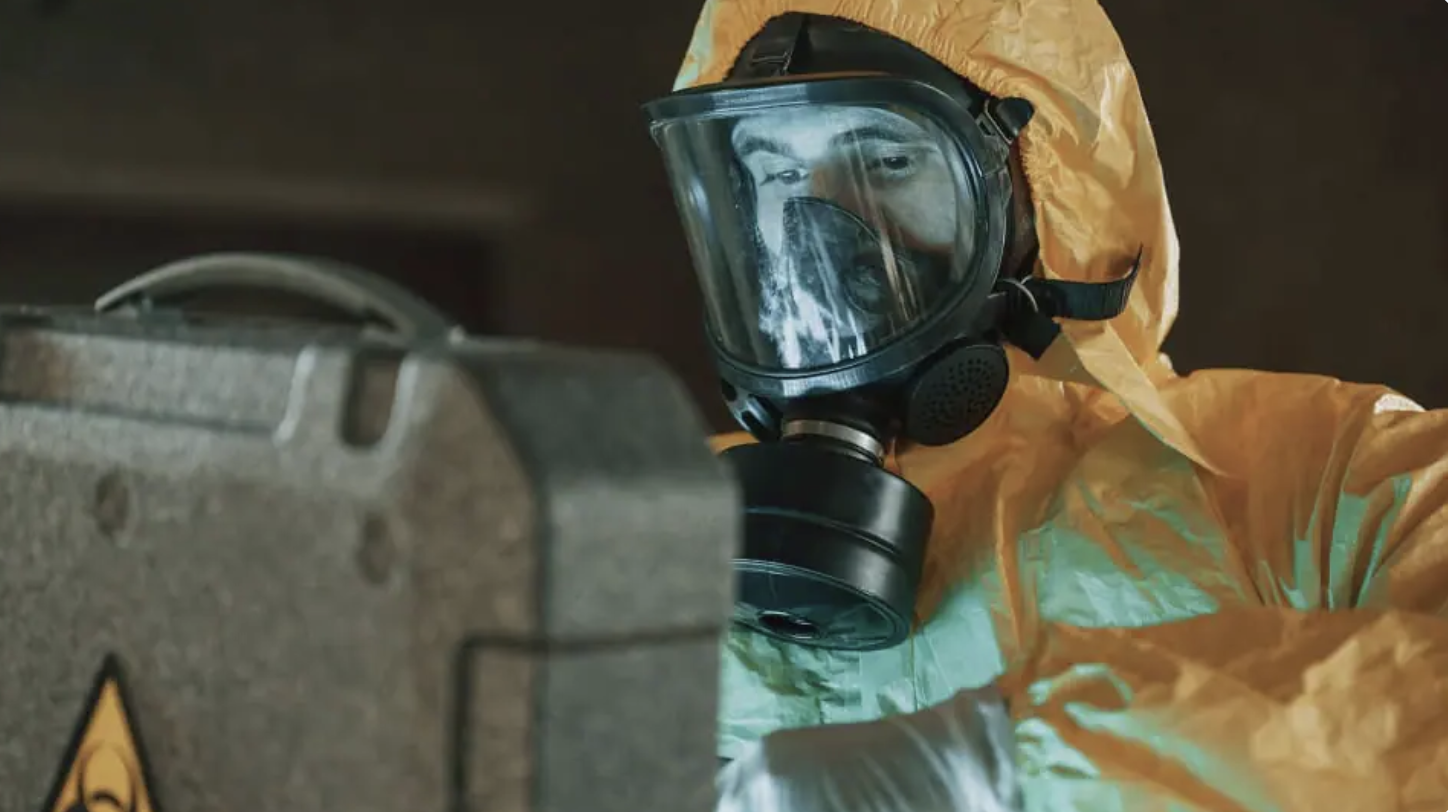
Griffin, C. (2025). Hydrogen sulfide: The silent assassin in oil & gas operations [png]. Veriforce. https://veriforce.com/blog/hydrogen-sulfide-the-silent-assassin-in-oil-gas-operations.
What is
hydrogen sulfide?
According to OSHA, “hydrogen sulfide [H2S] is a colorless gas that is extremely flammable and highly toxic”.[1] At low concentrations, this gas can smell like rotten eggs; however, at high concentrations H2S is undetectable to the human nose and can cause almost instant death by primarily inhibiting cellular respiration. When exposed to high concentrations of hydrogen sulfide, disruption of the mitochondrial electron transport chain occurs.
When the air has ‘a concentration of 700-1000 [ppm] H2S, the effect is rapid unconsciousness or immediate collapse within 1 to 2 breaths, breathing stops, and there is death within minutes. At a concentration of 1000-2000 [ppm] H2S, the effect is nearly instant death. [2]
Regarding atmospheric effects, there is a theory that was questioned during the creation of our nuclear weapons - is atmospheric ignition possible? [3] The atmosphere did not catch on fire when nuclear weapons were detonated in Hiroshima and Nagasaki. But the question remains: is atmospheric ignition possible?
According to OSHA, ‘the explosive range of hydrogen sulfide in the air is 4.3 to 45%.’ [2] If Earth’s atmosphere became saturated with this gas, it seems there is the potential for atmospheric ignition. Further, this gas would be coming from the ocean, specifically H2S eruptions at the deep sea vents, and seeping into the air. For this to happen, the ocean water would need to have a high concentration of H2S gas within it. The question must be asked, is oceanic ignition possible?
The scientific data implicates the presence of H2S gas in most extinctions as well as several die-off events. Hydrogen sulfide has been implicated in the end-Permian extinction, which is the largest extinction event Earth has ever seen. [5] According to MIT, the end-Permian extinction ‘killed off 96% of the planet’s marine species and 70% of it’s terrestrial life.’ [6] While these numbers are bleak, this glass can be looked at half-full: during the worst mass extinction this planet has ever seen, there was life that survived without any advanced preparedness efforts. With preparedness efforts, could the number of projected survivors increase?
With the help of Sozo Scientific, we can improve survival rates.
The first step is to map every unusual H2S event that our planet has seen since 2004.
See our H2S monitoring system.
Resources
[1] OSHA (n.d.) Hydrogen sulfide: Overview. US Department of Labor. https://www.osha.gov/hydrogen-sulfide?st_source=ai_mode#:~:text=HS%20can%20be%20found%20in:%20*%20Sewers,or%20eye%20irritation%20*%20Unconsciousness%20and%20death
[2] OSHA (n.d.) Hydrogen sulfide: Hazards. US Department of Labor. https://www.osha.gov/hydrogen-sulfide/hazards
[3] Flogeras, J. (2024) Could a nuclear explosion set earth’s atmosphere on fire. Advanced Science News. https://www.advancedsciencenews.com/could-a-nuclear-explosion-set-earths-atmosphere-on-fire/?st_source=ai_mode
[4] CAMEO Chemicals (n.d.) Hydrogen sulfide: Chemical identifiers. NOAA. https://cameochemicals.noaa.gov/chemical/3625#:~:text=Hazards,-What%20is%20this&text=Highly%20flammable;%20a%20flame%20can,to%20the%20source%20of%20leak.&text=HYDROGEN%20SULFIDE%20reacts%20as%20an,140%5D.&text=No%20information%20available.
[5] Bernstein, J. (2021) Deadliest period in earth’s history was also the stinkiest. UC Riverside News. https://news.ucr.edu/articles/2021/12/20/deadliest-period-earths-history-was-also-stinkiest#:~:text=The%20study%2C%20led%20by%20UC%20Riverside%2C%20shows,which%20helped%20to%20maintain%20the%20toxic%20cycle.
[6] Chu, J. (2018) An extinction without warning. MIT. https://news.mit.edu/2018/permian-period-extinction-0919